“Could an unfortunate pig trespassing into a potato patch truly cause two massive world giants to aim their loaded barrels at one another?
What brought the armies of the British Empire and the United States to the brink of war on a tiny island in the middle of the ocean was neither a grand lust for land nor a struggle for thrones…
It all began with an unlucky black pig shot by a single bullet. So, who do you think emerged victorious in this most absurd crisis in history?”
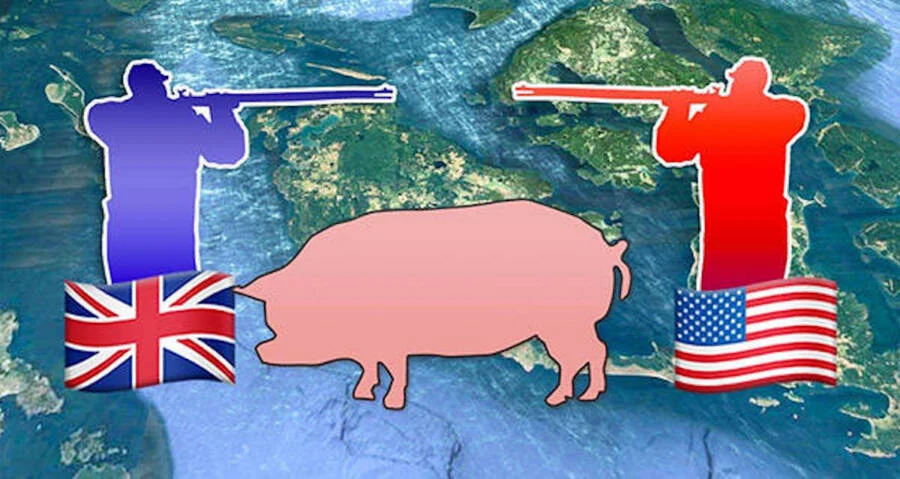
The Pig War was a military tension that erupted in 1859 between the United States and the British Empire on the San Juan Islands, located between present-day Washington State and British Columbia. The roots of this conflict lay in a geographical ambiguity within the Oregon Treaty of 1846. While the treaty set the mainland border at the 49th parallel, it stated that the boundary through the islands should run “through the middle of the channel which separates the continent from Vancouver’s Island.” The existence of two major channels—the Haro Strait and the Rosario Strait—led both nations to claim the strategically vital San Juan Island. By 1859, the island was home to both American settlers and employees of the British Hudson’s Bay Company.
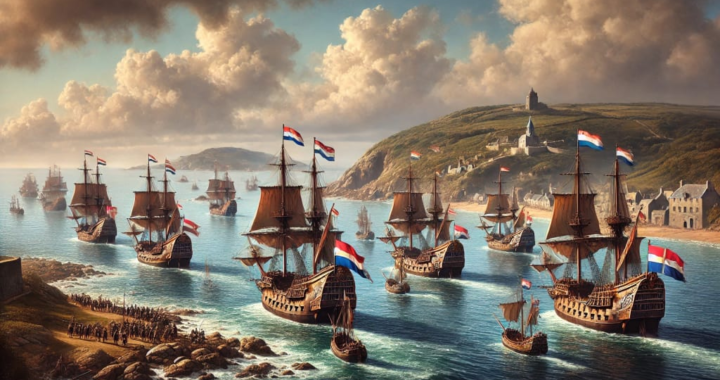
The concrete incident that triggered the crisis occurred on June 15, 1859, when an American farmer named Lyman Cutlar shot and killed a black pig belonging to a British official after finding it eating potatoes in his garden. Cutlar offered the pig’s owner, Charles Griffin, $10 in compensation, but the dispute escalated when Griffin demanded $100. When British authorities threatened to arrest Cutlar, the American settlers requested military protection. General William S. Harney, commander of the Department of Oregon, dispatched a company of 66 men under Captain George Pickett to the island, where they hoisted the American flag. In response, Britain sent three warships as a show of force, though commanders on both sides were ordered “not to be the first to fire.”
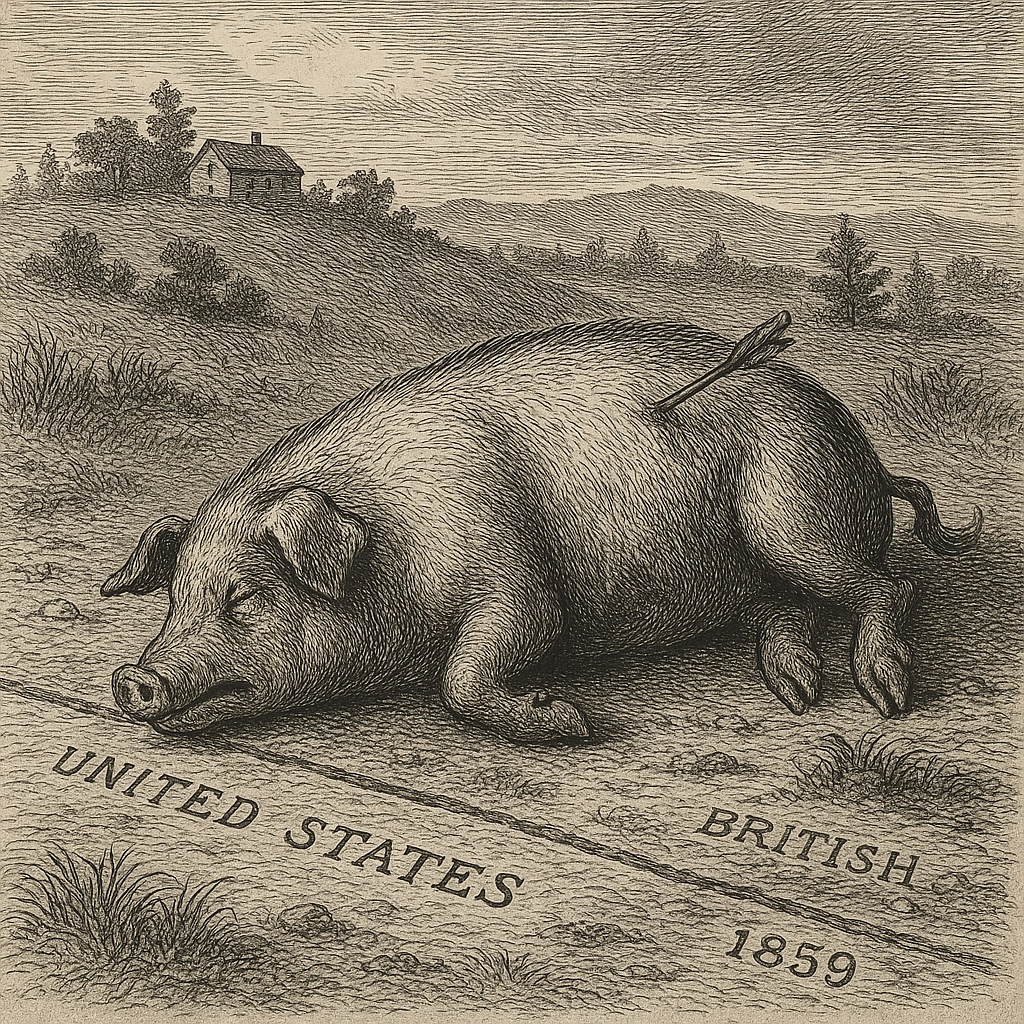
By October 1859, the crisis reached its peak, with 461 American soldiers facing off against five British warships, 167 heavy guns, and 2,140 marines. When news reached Washington and London, both governments realized they had no intention of entering a total war over a pig and initiated diplomatic contact. President James Buchanan sent General Winfield Scott to negotiate. The result was an agreement for “joint occupation” of the island until a permanent solution could be found. Under this arrangement, a British camp was established in the north and an American camp in the south, with a limit of 100 soldiers for each side.
This temporary status continued peacefully for 12 years, largely due to the distraction of the American Civil War. A final resolution was achieved via the Treaty of Washington (1871), which referred the border issue to international arbitration. In 1872, an arbitration commission led by German Emperor Wilhelm I ruled in favor of the Haro Strait, officially granting San Juan Island to the United States. British troops departed in November 1872, and American troops withdrew in 1874. The Pig War entered history as a rare military crisis where thousands of soldiers faced off for months, yet “the only casualty was a pig.”
Read more: The Pig War: How a Hungry Swine Almost Started a War Between the US and UKPhilosophical Perspective
Locke & the Ego of Property: The Pig War forces us to confront how fragile and absurd our concepts of “property” and “sovereignty” truly are. When examining this, we must consult John Locke, who argued that labor transforms nature into property. For Cutlar, the potatoes were the fruit of his labor; for Griffin, the pig was an asset. The philosophical irony here is how a private dispute over property evolved into a matter of “territorial integrity” for two empires. Locke’s theory of individual rights was hijacked by the massive egos of states, turning the life of a pig into a pawn in a geopolitical chess game that risked tens of thousands of human lives.
Rousseau & the Systemic Paralysis: If we bring in Jean-Jacques Rousseau and his “Social Contract,” the situation becomes even more intimate and strange. Rousseau argued that humans surrender rights to a “general will” for the sake of peace. However, on San Juan Island, we see not the rationality of the general will, but a collective entrapment within institutional rules. London and Washington, thousands of miles away, were not protecting the philosophical value of a pig, but the prestige of a line on a map. Rousseau would likely sigh at how these artificial systems (states) paralyze natural common sense. Once a system is established, the pig no longer matters; only the mechanical operation of abstract concepts like “honor” and “flag” remains.
Pascal & the Divertissement of Conflict: From another angle, we encounter Blaise Pascal’s observation on how humans find the strangest excuses to kill one another. Pascal believed humans seek “diversions” (divertissement) to fill their inner void. Perhaps this war was a massive act of “boredom” carried out over a piece of rock with no immediate strategic value. The fact that soldiers waited months without firing a shot suggests both sides recognized the absurdity of the situation but felt bound to remain “by the rules.”