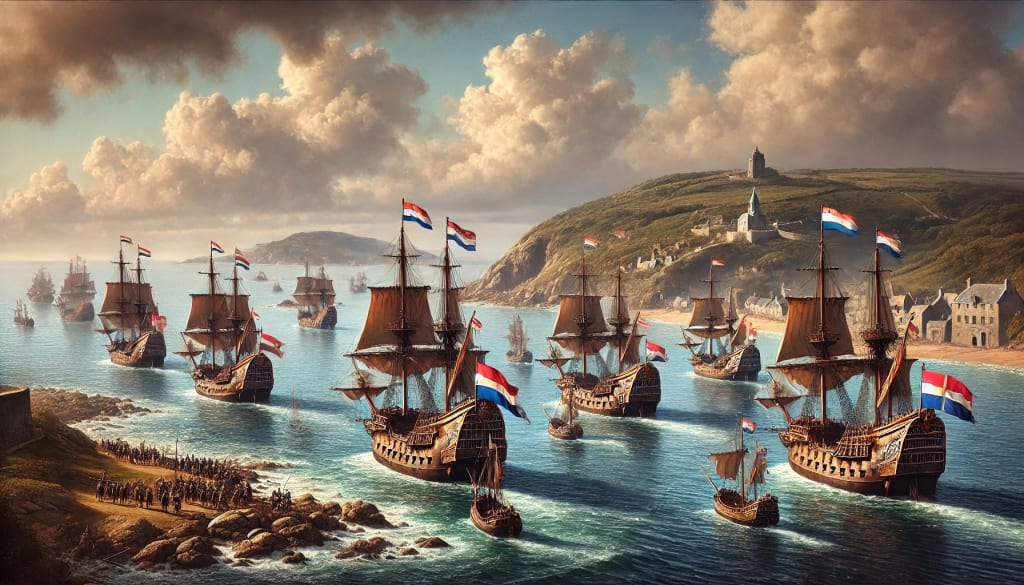
The Three Hundred and Thirty-Five Years’ War was a state of diplomatic conflict between the Netherlands and the Isles of Scilly, located off the southwest coast of England. It stands as the longest war in history, yet one in which not a single bullet was fired. The roots of the conflict lie in the English Civil War (1642–1651), fought between the Parliamentarians (Roundheads) and the Royalists (Cavaliers). During this period, the Netherlands sided with the Parliamentarians. When the Royalist navy was cornered by Parliamentary forces, they retreated to the Isles of Scilly, from where they launched attacks on Dutch merchant ships, causing significant losses. 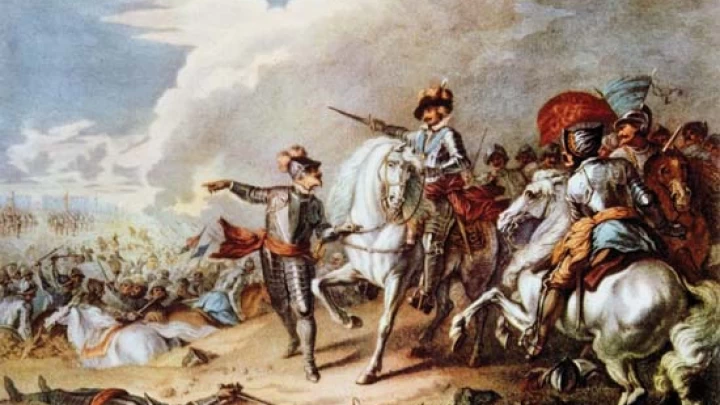
The official start of the war occurred on April 17, 1651. Dutch Admiral Maarten Tromp arrived at the islands to demand reparations from the Royalist fleet. When his demands were rejected, he officially declared war on the islands. However, shortly after this declaration, in June 1651, the Parliamentary Admiral Robert Blake forced the Royalist fleet to surrender, bringing the Isles of Scilly under Parliamentary control. Since their primary enemy—the Royalists—had been cleared from the area, the Dutch fleet returned to port without engaging in any military action. However, during this departure, the state of war was never officially rescinded, and the signing of a peace treaty was forgotten.
For three centuries, this diplomatic vacuum went unnoticed. The conclusion of the war came to the agenda in 1985, when Roy Duncan, historian and Chairman of the Isles of Scilly Council, investigated local legends suggesting that “Scilly was still at war with the Netherlands.” Duncan contacted the Dutch Embassy in London to clarify the situation, and subsequent archival research confirmed that, legally, the war was indeed still ongoing. Dutch authorities verified that the 1651 declaration of war had technically never been revoked, and peace had never been established.
The official end of the war and the peace process were completed on April 17, 1986—exactly 335 years after the declaration. The Dutch Ambassador, Jonkheer Rein Huydecoper, visited the Isles of Scilly to sign a peace treaty that was symbolic yet legally binding. During the ceremony, the ambassador joked about the relief the islanders must feel knowing they were no longer under the threat of a Dutch attack; however, objectively, the situation was attributed purely to administrative oversight. With this 1986 peace document, the world’s longest “bloodless war” officially took its place in the dusty pages of history.
Read more: 335 Years’ War
Philosophical Perspective:
Baudrillard & the Simulation: The Three Hundred and Thirty-Five Years’ War is a magnificent example of bureaucratic absurdity where a forgotten signature on paper holds more authority than reality itself. Applying Jean Baudrillard’s theory of “Simulation,” we see that the map is sometimes more real than the territory. In this war, there were no exploding cannons or fallen soldiers; thus, no “war” existed in physical reality. Yet, on a legal and linguistic level, the war raged on. While people plowed their fields and lived their lives, the fact that they remained coded as “enemies” in state archives proves that the signifier (the declaration of war) preceded the reality (peaceful coexistence). For 335 years, the world was governed by the “official record” of an event that never actually happened.
Wittgenstein & Language Games: We must also acknowledge Ludwig Wittgenstein’s Language Games. Wittgenstein argued that the meaning of words lies in their use. For centuries, the Dutch and the people of Scilly never applied the word “enemy” to each other; they never used it. However, the institutional structure of language—the phrase “state of war” in dusty archives—attained an existence independent of its use. It became a “linguistic monster” living on its own, outside of human will. Even as people lived in peace, the language of the system kept them at war until someone stepped in to reconstruct that language game with the word “peace” in 1986.
Max Weber & the Iron Cage: The spirit of this war also hides Max Weber’s pessimistic but accurate observations on bureaucracy. Weber described the modern world as an “iron cage” where rationality and rules are so dominant that human flexibility is lost within them. This 335-year war is proof of the self-referential, sluggish, and sometimes entirely meaningless nature of bureaucracy. A single signature forgotten by a clerk can lock an international status for centuries. Frankly, this event whispers to us that while we think we live in the real world, we are actually extras within a “legal reality” constructed by states, laws, and paperwork. A piece of paper possesses enough power to suspend reality for 335 years—as long as no one thinks to disturb it.