“Welcome to those very first lines where modern fantasy literature and monster stories were born. However, there is a much deeper question we must stop and ask ourselves here: while reading the glorious epic of a hero, are we actually witnessing a savage ‘Bear-Man’ ritual that ancient pagan cultures tried to make us forget?
Are you ready to crack that etymological code hidden between the lines of history’s oldest epic poem?”
Beowulf is not merely a text where sword strokes and heroic shouts echo; it is a massive epic poem that tells of humanity’s loneliness in the universe and its inevitable end in the dark and misty Europe of the 8th century. The story begins with the joy of the grand Heorot hall built by the Danish King Hrothgar. However, this joy awakens a monster named Grendel, who emerges from the darkness. When viewed from a philosophical perspective, Grendel is the embodiment of being cast out of society, of envy, and of being “the other.” He perceives the music and laughter of the banquets as mere noise because he has no “table” or “belonging” of his own. At this very point, Beowulf arrives as a savior from across the ocean, from the south of Sweden (the land of the Geats).
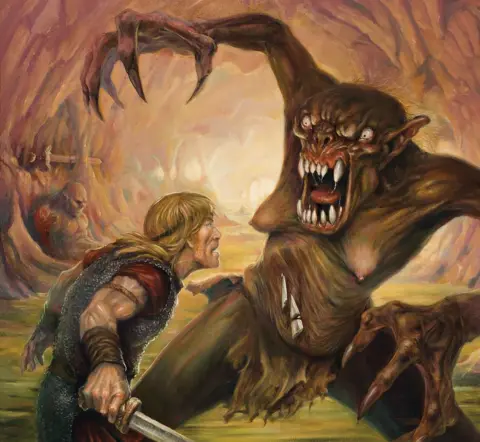
Beowulf’s first encounter with Grendel is an existential display of power rather than a technical battle. He refuses to use a sword; he wishes to subdue the monster with his own bare hands. This is a perfect example of Aristotle’s concept of “heroic virtue” (arete). The hero does not focus solely on the result, but on the character with which he achieves that result. When he tears Grendel’s arm from his shoulder, he physically shatters the wild nature that disrupts the order of society. Yet, the tragedy does not end there. When Grendel’s mother comes for revenge, Beowulf is forced to descend into the dark cave beneath the water—into the center of the subconscious and primordial fears. There, he can only win not with man-made swords, but with an ancient power left from the giants. This is the process of man confronting his own shadow.
The elderly Beowulf, appearing after a fifty-year reign, represents the most jarring and philosophical part of the epic. The young, invincible warrior is gone; in his place is a wise king carrying the responsibility of his people. When a dragon awakens due to a thief’s greed and sets the kingdom ablaze, Beowulf knows his end has come. Here, the Anglo-Saxon concept of “Wyrd” (Fate) comes into play. This understanding of fate dictates that a person does their best and waits for the result with fortitude. While all the other warriors flee in fear, Beowulf faces the dragon with only his loyal friend Wiglaf. He kills the dragon but is himself mortally wounded.
To speak sincerely, Beowulf’s death is not a defeat but a completion. By killing a dragon, he saved not just gold, but the future of his people, giving his own life in exchange. The funeral pyre lit for Beowulf at the end of the epic symbolizes not just the passing of a hero, but the closing of an era. While the monument erected over his grave serves as a guide for passing sailors, it actually tells us this: human life is condemned to brevity and darkness; yet, the only thing that shines within this darkness is a person’s will to “do what is right.” Beowulf is a sad yet honorable farewell that reminds us that monsters will always be there, but the courage to face them is what makes us “human.”
—British Epic—