“Could a man abandon the woman he loved enough to cross an entire ocean for, leaving her in the midst of roaring flames just because of public gossip? The Ramayana is the story of that most tragic and darkest crossroads, where a god-king at the absolute pinnacle of perfection finds himself trapped between the agonizing demands of justice and love.”
The Ramayana is a monumental epic consisting of approximately 24,000 verses, serving as the cultural, religious, and moral compass of South Asia for millennia. This narrative is not merely a collection of a prince’s adventures; it is the earthly reflection of the search for the ideal human, the essence of loyalty, and the preservation of cosmic balance (Dharma). At the heart of the story is Rama, the Prince of Ayodhya, born as the seventh avatar of the God Vishnu. Rama is not just a hero; he is the embodiment of the perfect son, the perfect brother, the perfect husband, and the perfect king.
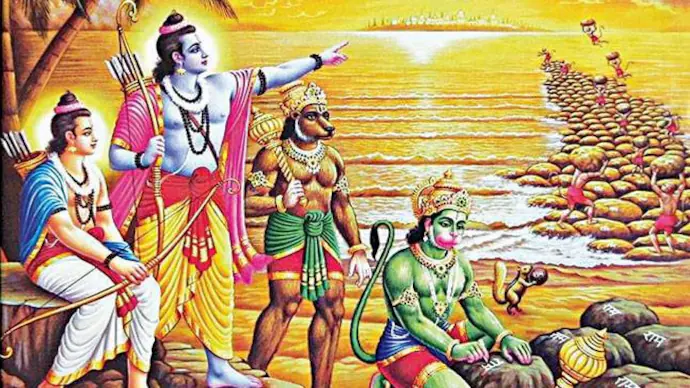
The epic begins with Rama being sent into exile in the forest for 14 years, forced to relinquish his throne due to an unfortunate promise made by his father, King Dasharatha. Without a shred of rebellion against this unjust decision, Rama gives up his crown and enters the forest like a dervish to protect his father’s honor. Accompanying him are his wife, Sita—the symbol of devotion—and his brother, Lakshmana. However, this peaceful life of exile turns into a great war when the ten-headed king of evil, Ravana, abducts Sita and takes her to the island of Lanka. To rescue Sita, Rama forms an alliance with Hanuman, the leader of the monkey army who possesses divine strength. A massive bridge is built across the ocean, great battles are fought, and eventually, Rama defeats Ravana, the representation of evil, reuniting with his wife and reclaiming his throne.
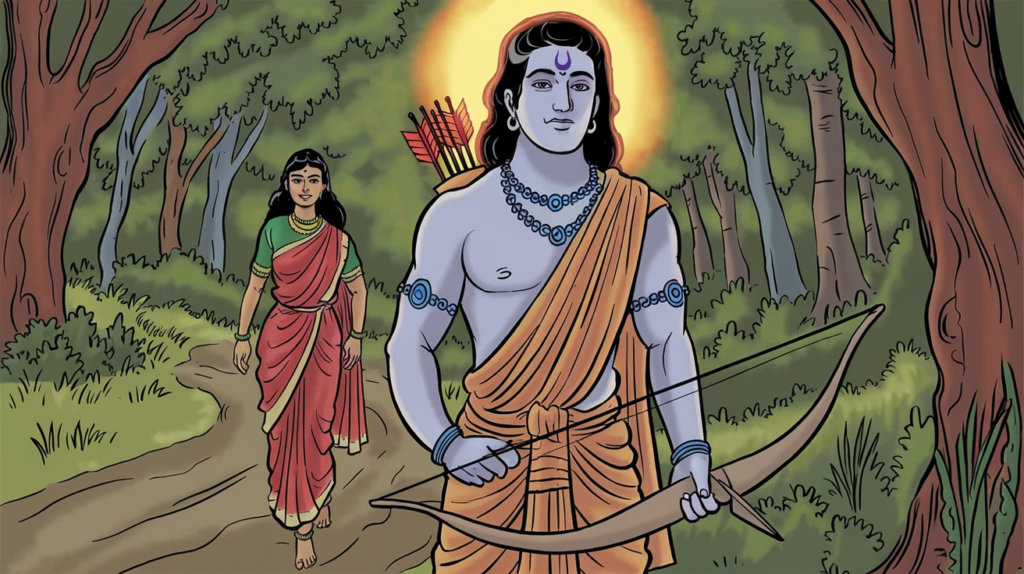
When we examine this epic with philosophical depth, the first concept we encounter is Dharma—universal duty and moral order. There is an intimate connection between Immanuel Kant’s “categorical imperative” and the Ramayana. Kant argues that an action should be performed not for its consequences, but because it is a duty. Rama is the personification of this; he chooses “what is right” (Dharma) over happiness or the kingdom. Even when his wife is kidnapped or his kingdom is taken away, he does not compromise his ethical principles. His war is not just against a physical enemy, but a struggle to preserve order against chaos.
Here, one must also recall Plato’s ideal of the “Philosopher King.” According to Plato, the state should be ruled by a wise and virtuous monarch. Rama is the Eastern twin of that ideal ruler who does not place personal desires above society and justice. Yet, as we delve deeper into the story, we see a wholeness of nature similar to Spinoza’s pantheist approach. Hanuman and the monkey army represent the cooperation of nature and the animal kingdom with the divine. The Ramayana reminds us that every part of the universe—be it a dervish, a monkey, or a tree—is a component of that grand cosmic balance.
To speak sincerely, the Ramayana is the unending dialogue between the “good” and “evil” within a human being. Ravana’s ten heads actually symbolize ten different passions and egos (such as anger, pride, and lust). Rama’s arrow is the victory of the mind and spirit that shatters these egos. At the end of the epic, Rama’s victory is a celebration, but it is also a heavy responsibility. It whispers to us: true victory is not defeating another, but refusing to abandon one’s own virtue even under the most difficult conditions. The Ramayana is the most aesthetic and spiritual narrative of man’s struggle to find his “inner Dharma” on a journey stretching from mournful forests to magnificent palaces.
—Indian Epic—