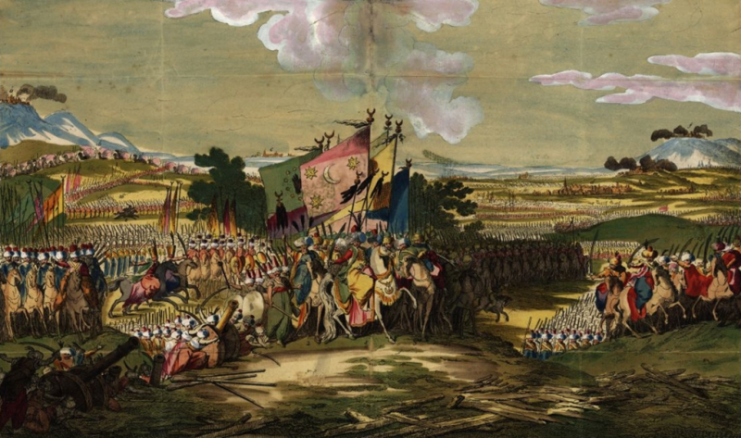
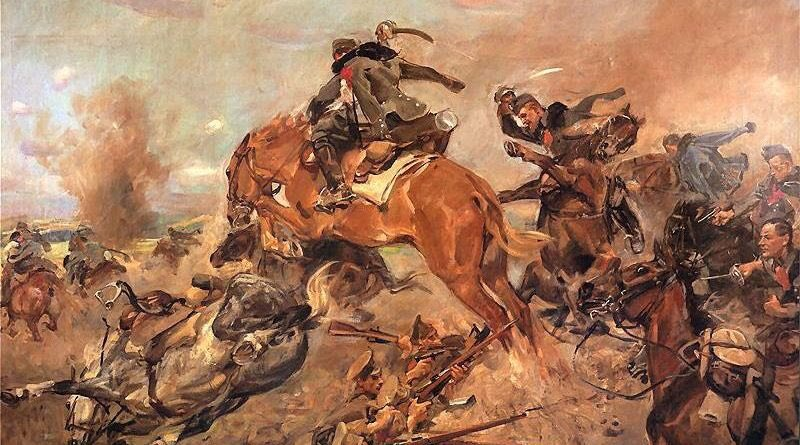
The Austrian Emperor Joseph II organized a grand campaign against the Ottomans. The army set up camp near the town of Karánsebes. In the evening hours, the vanguard of the army, a hussar (cavalry) regiment, crossed the Timiș River for reconnaissance. While expecting to find Ottoman soldiers on the opposite bank, they encountered a group of Romani nomads. The nomads had a plentiful supply of schnapps (a strong liquor/spirits).The tired and thirsty cavalrymen bought the spirits and began to drink. After a while, a group of infantrymen who crossed to this side of the river saw the cavalrymen drinking and wanted to join in. However, the cavalrymen had no intention of sharing their loot; they set up a barricade around the barrels of liquor. The argument quickly turned into a brawl, and tensions rose.During the brawl, an irritated soldier (or a cavalryman), in order to scare the infantry away from the drink, fired a shot into the air and shouted “Turci! Turci!” (Turks! Turks!). The soldiers, who had already been expecting an Ottoman raid for days, took this prank seriously under the influence of alcohol. The cavalrymen jumped on their horses and began galloping toward the inside of the camp to escape.The infantry coming from behind mistook the cavalrymen rushing toward them in the dark for “Ottoman raiders” and opened fire. At that moment, hell broke loose on both sides of the river.The Austrian army was a multi-ethnic structure; it contained Austrians, Serbs, Croats, Italians, and Hungarians. While officers trying to calm the army shouted “Halt! Halt!” (Stop!) in German, the other ethnic groups who did not know German heard these shouts as “Allah! Allah!”, the battle cry of the Ottomans.This linguistic accident pushed the panic to an irreversible dimension. In the darkness, no one recognized anyone. A cavalry regiment commander, thinking there was an enemy unit infiltrating the camp, started artillery fire upon his own soldiers. A full-blown “war of all against all” began in the middle of the camp. Soldiers burst out of their tents and bayoneted every shadow they encountered.The chaos was so great that while Emperor Joseph II was trying to control the situation, he was knocked off his horse. According to rumor, the emperor, mistaken for the enemy by his own guards, jumped into the river to save his life and got stuck in the mud on the bank. The massive Austrian army left the town, fighting its own shadow until morning.Two days later, when the real Ottoman army (units under the command of Grand Vizier Koca Yusuf Pasha) reached Karánsebes, they were in a state of astonishment. Approximately 10,000 dead and wounded Austrian soldiers were lying on the field. The army had fled, leaving behind all its ammunition, cannons, and treasury. The Ottomans won an absolute victory without swinging a single sword.
Read more: Şebeş War
Philosophical Part:
Ludwig Wittgenstein’s famous saying, “The limits of my language mean the limits of my world,” turns into a full “border violation” at Şebeş. Imagine; the officer shouts “Stop!” (Halt), but the soldier’s mind translates that sound as “Allah” (The Enemy). If we look through the perspective of Ferdinand de Saussure, the bond between the “signifier” (sound) and the “signified” (meaning) is severed here. Language is no longer a tool for agreement but becomes a chaos machine. People hear the same word, but everyone is trapped in their own tunnel of fear. When communication fails, the only thing left speaking is the rifles.Nassim Taleb’s “Black Swan” theory is right before us here. You calculate everything in strategy rooms; logistics, ammunition, the number of enemies… But no one adds a barrel of liquor on the opposite bank to the equation. Here, Albert Camus’s philosophy of the Absurd comes into play: Man seeks a rational meaning, an order in history and life (strategy, hierarchy); but life throws “10 thousand corpses shooting each other over a barrel of schnapps” at him. Şebeş is the pathetic defeat of human planning against that famous “absurdity” of the universe.
The image of the “Terrifying Other” (the Turk), described by Edward Said in Orientalism, is so ingrained in the minds of the Austrian army that there is no need for a real enemy on the field. The enemy is no longer outside, but in the subconscious of the soldier. If we adapt Jacques Lacan’s “Mirror Stage” here; the army codes its own reflection encountered in the dark (its own comrade-in-arms) as “The Enemy.” This is a complete mirror catastrophe. The army that shoots itself is actually fighting the fear it created. When violence loses its target, it turns and hits the owner himself. This is the power being poisoned by its own paranoia.
According to Giorgio Agamben’s theory of the “State of Exception,” in that moment of panic, all rules, ranks, and law evaporate instantly. That first fire started in Şebeş creates a “state of emergency” and returns to that dark place Thomas Hobbes mentioned: “the war of all against all.” Achille Mbembe’s concept of Necropolitics (Politics of Death), on the other hand, works ironically in reverse here: Normally, power uses its right to kill the enemy. But at Şebeş, power (the army) loses control and directs this killing power toward its own body. This is the self-destruction of the system, a kind of “suicide of sovereignty.”
“Semiotic Shift”: A sound (Halt) taking on a completely opposite and destructive meaning (Allah) within a different cultural code.
“Auto-Immune Violence”: A structure internalizing the perception of an external threat so much that it eventually directs its defense mechanisms toward its own organs.
“Absurd Heroism”: The dark humor created by the massive military effort displayed for the sake of nothingness (for a barrel of schnapps).
“Babel Syndrome“: The fact that a multi-ethnic structure, in a moment of crisis, sees each other as “foreigners” and “monsters” due to the lack of a common ground of meaning.