“What could be the most horrifying object to place in a woman’s bedroom? The Russian Tsar, Peter the Great, did not settle for punishing betrayal with mere death; he placed that severed head into a jar filled with alcohol and set it right by his wife’s bedside.
So, what was that dark obsession with power that transformed this genius leader, the builder of modern Russia, from a sovereign into a bedroom nightmare?”
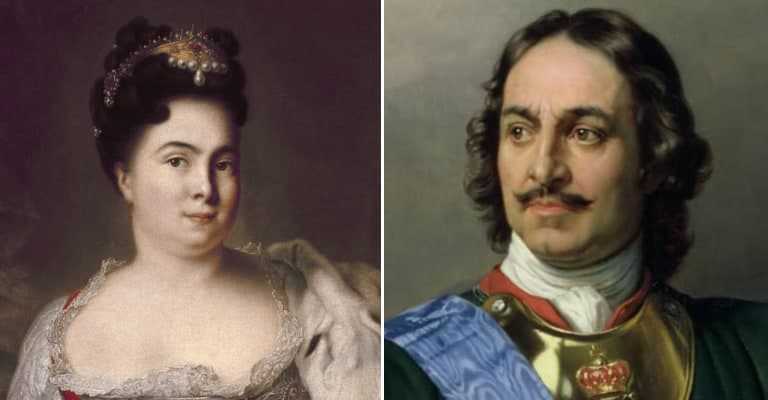
Peter the Great was a man who built cities and trained armies to turn Russia into a massive empire. However, this desire for absolute control on the outside suffered a breach within the private walls of his palace. When he discovered that his wife, Catherine, was having a secret affair with Willem Mons—his chamberlain and a close associate—the world stood still for Peter. For a man like Peter, who sought to bring even nature to its knees, his wife losing her heart to another was not an acceptable “mistake”; it was an assassination attempt against his authority.
The Moment When Execution Was Not Enough Peter immediately had Willem Mons arrested. Instead of accusing him directly of adultery (as this would tarnish his own honor before the public), he sentenced Mons to death for state crimes such as bribery and corruption. When the day of execution arrived, Mons was beheaded in the square. But for Peter, this was not an end, but merely a beginning. He did not want to send Mons to the grave and close the matter; he wanted to imprison this betrayal into an eternal “now” for his wife, Catherine.Following the execution, Peter ordered Mons’s severed head to be brought to him. He had a special chemical solution prepared, similar to those used for the “museum of oddities” (Kunstkamera) he had established due to his scientific curiosity.
Mons’s handsome and pale face was placed inside a massive glass jar filled with alcohol.The next morning, when Empress Catherine woke up, she was met with the face of her lover—executed just the day before—floating behind glass on the nightstand right next to her bed. Peter had strictly forbidden the jar from being removed. Catherine would now open her eyes to this horror every morning and sleep under these dead gazes every night. Peter did not harm his wife physically; he did not throw her into a dungeon.
He simply imprisoned her in the same room with the unrotting image of her own conscience and her lost love.For months, Catherine lived in that room, looked at that jar, and watched Peter sit across from her silently during dinners. This move by Peter opened a wound much deeper than any executioner’s sword. That jar was not just a severed head; it was Peter’s petrified eye, watching his wife at every moment and saying, “You made a mistake, and I see everything.” At the point where love ended, power had turned fear and guilt into a piece of decorative art.
Read more: Peter the Great’s Head in a JarPhilosophical Dimension:
Peter the Great’s maneuver is the point where power is not satisfied with merely taking a person’s life, but transforms the memory of that life and the body left behind into an “instrument of psychological control.” Through this case, let us analyze the dark relationship between power, body, and mind on a philosophical ground.
When Peter placed that jar in Catherine’s bedroom, he essentially constructed one of history’s most jarring examples of the Panopticon. Catherine was no longer alone in that room; the dead face of the man she once loved became Peter’s never-closing eye, saying at every moment, “I know your betrayal.” This is a form of surveillance where power monitors its subjects not only in public squares but even in the most intimate spaces, leaving nowhere to hide.
The primary horror encountered here is Peter’s understanding of Necropolitics. Mons’s body was not left to rot underground; on the contrary, it was “frozen” as a carrier of a political message. Power does not release the body even after death; it continues to use it as an object of public or private fear. This situation is a direct example of Symbolic Violence. Peter never laid a hand on his wife, but by imposing the necessity of looking at that jar every morning, he created a spiritual paralysis far deeper than any physical torture.
The transformation of Mons’s once-beloved face into a soulless object behind alcohol-filled glass also reveals the aesthetic power establishes through the Grotesque Body. The sublime (love and the human countenance) is blended with the disgusting and the objectified. With this move, Peter establishes total dominance over the Management of Emotions; he turns the woman’s mourning, love, and fear into tools of punishment. Catherine is no longer just an Empress, but a prisoner left alone with her own conscience in her own bedroom.
Panopticon: A mechanism that creates the feeling of being watched at every moment, ensuring the individual controls their own behavior.
Necropolitics: The absolute dominance of political power not only over the living, but over how dead bodies are displayed and transformed into objects of fear.
Symbolic Violence: A method of paralyzing a person’s will and spiritual integrity through symbols, images, and psychological pressure, without striking a physical blow.
Grotesque Body: The removal of a human part (the head) from its natural context and its transformation into an object, becoming a tool for a political message through fear and disgust.
Management of Emotions: The use of an individual’s most intimate emotions (love, mourning, fear) by power as fields for political control and punishment.