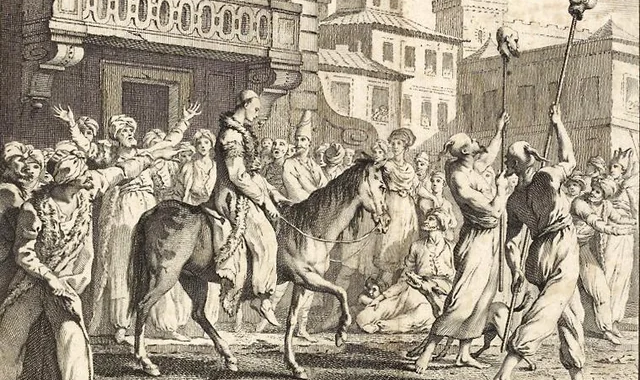
In the classical period Ottoman palace hierarchy, “the presence of the Sultan” is a sacred space where worldly noises are cut off. The Sultan is separated from his subjects and even the highest-ranking statesmen by a massive distance. This distance is not only physical but also acoustic. From the reign of Mehmed the Conqueror onwards, sultans began to watch divan meetings from behind a cage and ceased to speak directly.This “sacred silence” culture, when combined with the state’s darkest business—execution—gives rise to the mute executioners. Power sought to push the terrifying noise of the act of killing (screams, pleas, last words) outside the system. Because a pleading voice might cause the executioner to hesitate or damage the image of “divine justice” associated with the execution.This special group, working under the Chief Executioner, was usually chosen from among those who were deaf and mute. The primary reason for this was so they could not hear the victim’s final cries and could not tell anyone outside what had happened within.Execution Scene: When the victim (mostly a statesman or a prince) was brought before the “Executioner’s Fountain” or into a dark room where the mutes waited, not a single word was spoken. The mute executioners would approach their victims only with signs, emphasizing the finality of the decision with this eerie silence. Where speech ended, the executioner’s hands and the famous “kemend” (silk noose) took over. The rattling sound made by the victim while taking their last breath would be the only sound echoing off the marble walls of the palace. This silence transformed death from a “work accident” or a “brawl” into a mechanical process that functioned like an inevitable natural phenomenon of the state.After the execution was over, the executioners would return to their silence as if nothing had happened. However, the price of this silence was heavy:Executioners were considered “ill-omened” among the people. Therefore, when they died, they were not buried in normal cemeteries, but in secret places consisting of unnamed, stoneless, and rough marble blocks called the “Executioner’s Cemetery.”A cellat being mute meant that the state’s greatest secrets went silently to the grave with that executioner. They were both the hand and the locked box of the power.This practice created a massive psychological pressure on the Ottoman bureaucracy. For a statesman, coming eye-to-eye with a mute official in the palace corridors was like a rehearsal for the moment when words ended and death silently approached.
Read more: The Silent Corridors of the Sultan: Mute Executioners
Philosophical Part:
Normally, an execution scene is noisy; there are pleas, curses, or last words. But when the executioner is mute, the human bond between the victim and the executioner (the bridge built through language) is blown up from the start. We can read Ludwig Wittgenstein’s famous “The limits of my language mean the limits of my world” in reverse here: By taking the tongue of the executioner, power closes the world of the victim at that moment. Before you stands a “wall” that does not hear you and cannot answer you. This situation removes power from being a human and transforms it into an inevitable object like a law of nature.
Giorgio Agamben’s “Homo Sacer” (Bare Life) concept stands right before us here. When a mute executioner approaches the victim, that person is no longer a statesman, a prince, or a subject of law. The silence of the executioner reduces the victim to a body that only breathes, outside the law. The executioner is mute because power does not establish a relationship “worth talking to” with the person it kills; it only terminates that body biologically. This silence is the clearest sound (or silence) that the victim has been removed from “human society.”
Michel Foucault talks about those surveillance towers (Panopticon) from which power watches us at every moment. In the Ottoman palace, there is an “acoustic” version of this. The wandering of mute executioners in the palace corridors is a kind of “tyranny of silence.” Everyone knows that a noose can wrap around their throat at any moment and when that moment comes, there will be no one to hear you. This silence creates a tremendous internal discipline over the palace bureaucracy. No one speaks loudly, no one objects; because in a place where there is no voice, truth is only the will of the Sultan.
“Violence without Communication” (Hannah Arendt Perspective): Arendt says that where violence begins, speech ends. The mute executioner is the purest form of violence; because no discussion, defense, or “why” question can leak into it. He just does.
“Aesthetics of Necropolitics” (Achille Mbembe): Death is not just an end but a form of governance. The muteness of the executioner makes death so ordinary and mechanical that the killing power of the state is shrouded in a sacred silence.
“Symbolic Castration”: The absence of the executioner’s tongue (and sometimes ears) is actually the power “dehumanizing” its own instrument of violence. Power removes the executioner from being a subject and reduces him to the level of a “tool” (like a sword, for example).
“Dehumanization”: The suspension of the human qualities of both the executioner and the victim. The victim becomes a “package,” and the executioner becomes a “mechanism.”