The case of the “Monkey Executions” in Istanbul is a dark narrative of how a society can lose its rationality within the grip of collective madness and religious fanaticism, and how an animal’s body can be transformed into an object of political hatred. Occurring in the 1590s during the final years of Sultan Murad III’s reign, this event began under the pretext of a “moral cleansing” and spiraled into a mass slaughter. At the center of the story was Molla Abdülkerim Efendi, a man deeply respected by the Sultan and capable of manipulating the masses with his oratory, yet whose mind was clouded by an obsessive perception of “sin.”
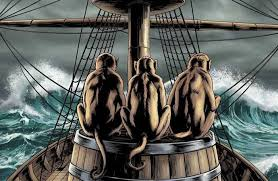
It all began with the significant role monkeys played in the cosmopolitan structure of Istanbul at the time. Brought primarily from North Africa by sailors, these monkeys were not just pets; they were a vital workforce for the maritime industry. These “lookout” monkeys would climb to the top of masts and scan the horizon with their keen eyes, serving as an early warning system that saved ships from pirate attacks or shallow rocks. However, the fact that these animals were sold in shops in Galata and Azapkapı and were found in high concentrations in non-Muslim neighborhoods and on ships ignited a distorted narrative in the mind of Molla Abdülkerim Efendi. The Molla began a series of sermons claiming that monkeys “corrupted women,” acted as intermediaries for prostitution, and were satanic entities used to subvert the morality of Muslims.
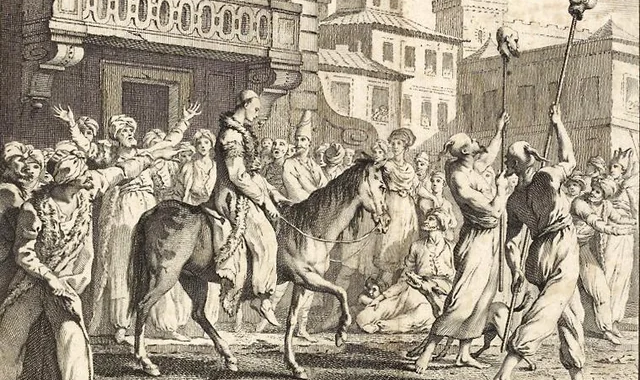
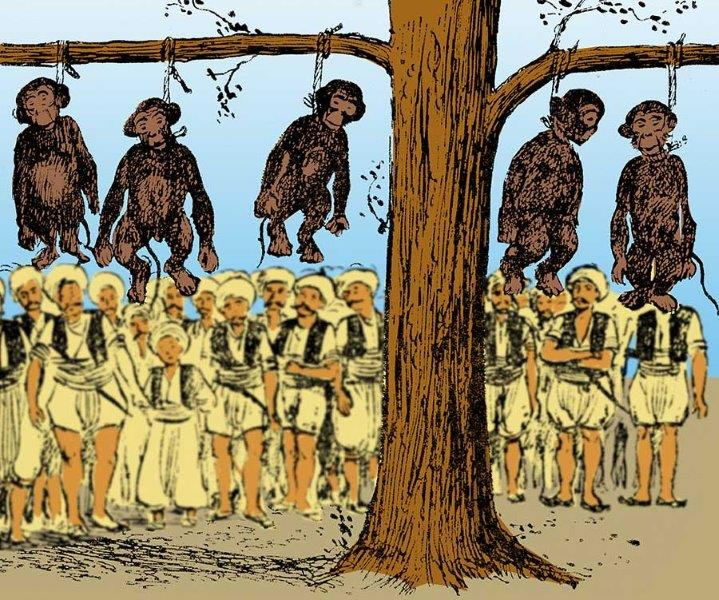
The breaking point occurred when the Molla led a mob of thousands, incited after a Friday prayer, to raid the monkey shops in Galata. This angry crowd scoured the city street by street and shop by shop, rounded up every monkey they could find. It was here that Molla Abdülkerim Efendi’s tragicomic yet chilling sense of “justice” came into play; instead of simply killing the monkeys, he treated them as “criminals” and had special gallows erected for each one. The Molla personally hanged these innocent animals from tree branches. For days, the people of Istanbul were forced to witness the corpses of monkeys swaying from trees, and due to this horrific spectacle, Abdülkerim Efendi went down in history as “Maymunkeş” (The Monkey-Slayer).
Following this massacre, Istanbul’s maritime culture and commercial life took a major hit, but the most significant blow was dealt to the collective memory. Although “Maymunkeş” Molla was promoted to high offices like the Chief Justice of Rumeli shortly after, the public’s hatred never left him. It is rumored that when he died in 1593, animal lovers and sailors in Istanbul held secret celebrations, and no one offered a single blessing in his wake. On a philosophical level, this event is the most grotesque form of “Anthropocentric Violence”; when power cannot solve the actual problems of society, it selects a voiceless and defenseless “scapegoat” to prove its authority, projecting violence onto a non-human body to certify its own “moral sanctity.” The execution of the monkeys is a portrait of the moment when law turns into theater and justice becomes a ritual of madness.
Read more: The “Monkey Executions” of Istanbul
Philosophical Perspective:
Nietzsche & The Shadow: From Friedrich Nietzsche’s sharp perspective, when a human cannot face their own “animalistic” impulses or social corruption, they seek a scapegoat to dump this filth upon. Molla Abdülkerim projected what people called “immorality” onto the monkeys. By hanging the monkeys, he was essentially executing the “human shadow”—those repressed desires. The animal served as a mirror; the Molla hated the reflection, so he broke the mirror.
Foucault & Biopolitics: Michel Foucault’s concept of Biopolitics intensifies here. Normally, the state monitors and aligns human bodies. But in this case, the authority (represented by the Molla) extended its domain of control beyond the human species. Turning a monkey’s body into a “judgable criminal” is an attempt by authority to seize nature itself. It says: “I decide not only how you live but also by what moral code a stray animal dies.” This is the dangerous threshold where authority plays God.
Bakhtin & Baudrillard: Mikhail Bakhtin’s concept of the “Grotesque” fits perfectly here. The application of a serious institution like justice (court, execution) to a monkey turns the event into a horrific comedy. Through Jean Baudrillard’s lens, there is no real law here, only a “simulation” of law. There is no culprit and no crime, yet a massive gallows stands on the stage. Justice becomes a hollow but bloody performance staged to terrorize the public.
Derrida & Silence: Jacques Derrida emphasizes the “inability to respond” when discussing the human gaze toward animals. A monkey cannot defend itself or say, “I am innocent,” before being hanged. Power loves this absolute silence. The monkey’s wordlessness allowed the Molla’s voice to become absolute power. Finding an “other” that cannot object, the authority displays its madness in its purest form.
“Anthropocentric Megalomania”: The human tendency to place their own morality at the center of the universe and deem anything that does not fit (even a monkey) as an enemy.“Symbolic Violence”: Using the bodies of monkeys as a “billboard” to intimidate sailors, dissidents, or those living differently.“The Absurdity of Necropolitics”: The power to dictate death detaching from rational cause and transforming into a “ritual of insanity.”