“Modern science tells us that the universe was born of an explosion; Babylonian mythology, however, claims that the cosmos was constructed from the cleaved corpse of Tiamat, the mother of monsters. Was the order of the cosmos, in reality, the work of a sacred murder?
You are invited to the world’s first great cosmological war, and to that relentless clash between order and chaos.”
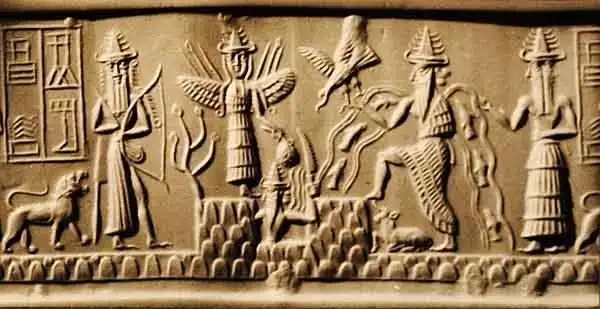
The Enuma Elish is a Babylonian epic consisting of seven clay tablets that recount the cosmogony (the creation of the universe) and the theogony (the genealogy of the gods) of Ancient Mesopotamia. It derives its name from its opening line, “Enūma eliš lā nabû šamāmū,” which translates to “When on high the heaven had not been named.” Although most discovered copies date back to the 7th century BCE from the library of the Assyrian King Ashurbanipal, the roots of the epic are widely accepted to reach back to the 18th century BCE, during the rise of Babylon.The plot begins with two primal forces—personifications of the chaotic waters at the dawn of existence: Apsu, the god of fresh water, and Tiamat, the goddess of salt water.
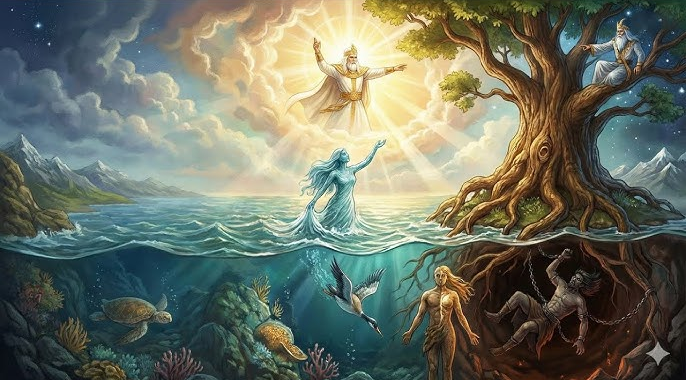
The mingling of these two primordial waters gives birth to the other gods. However, the noise and activity created by the younger gods disturb Apsu, who desires silence. Apsu decides to destroy his children, but Ea (Enki), the god of wisdom, learns of the plot, casts a spell to put Apsu into a deep sleep, and kills him. Ea establishes his own dwelling atop Apsu, where his son Marduk, a being of superior abilities, is born.
Enraged by the death of Apsu and incited by other gods, Tiamat creates a massive army of monsters to seek revenge, appointing her son Kingu as their leader. Tiamat becomes the ultimate symbol of chaos and destruction. When the other gods find themselves helpless against the terror she has unleashed, the young hero Marduk steps forward. In exchange for stopping Tiamat, Marduk demands absolute leadership over the gods. The council of gods accepts his proposal and proclaims him their king.
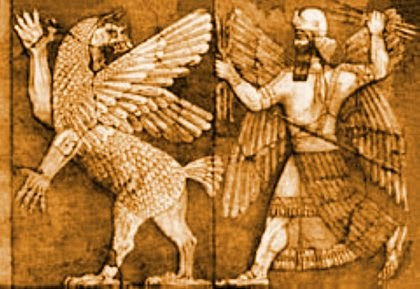
Equipped with storms, winds, and seven-headed beasts, Marduk enters into a monumental battle with Tiamat. He uses the winds to hold Tiamat’s mouth open and strikes her heart with an arrow, killing her. Following his victory, Marduk splits Tiamat’s massive body in two, like a dried fish; from one half, he fashions the heavens, and from the other, the earth. From Tiamat’s tears, the Tigris and Euphrates rivers are born. He seizes the “Tablets of Destiny” from Kingu and fastens them to his own chest. Finally, to serve the gods and allow them to rest, Marduk creates humanity by mixing Kingu’s blood with clay. The epic concludes with the construction of the city of Babylon and the Esagila temple in honor of Marduk, as the gods chant his fifty names to bless his absolute sovereignty.
The Enuma Elish is not merely a creation myth; it is a text that legitimizes Babylon’s religious and political authority over Mesopotamia. It chronicles the transition of power from the old Sumerian deities to Marduk, the local god of Babylon, and depicts the “birth of order out of chaos.” This epic profoundly influenced many subsequent religious texts and mythologies, particularly narratives regarding creation and the great flood.
—Babylonian Epic—