“A sanctuary completely isolated from the outside world, surrounded on all sides by iron mountains stretching toward the sky…
Why did a nation on the brink of extinction have to melt a whole mountain just to escape the valley they had hidden in for centuries? And more importantly; was that sky-maned wolf, who showed them the way out of this dark labyrinth, merely a legend, or was it one of the oldest genetic codes in history?”
The Epic of Ergenekon is one of the most vital foundation stones of Turkic mythology and historical consciousness. It is an epic narrative that focuses on the origins of the Göktürks—their narrow escape from the brink of extinction and their subsequent rise to re-establish a global empire. The primary sources for the epic are the 13th-century historian Rashid-al-Din Hamadani’s work Jami’ al-tawarikh and later, Abu al-Ghazi Bahadur Khan’s Shajare-ye Terakime. This text, transitioned from oral tradition to writing, chronicles how the Turks emerged from a moment of historical crisis through a “rebirth.”
The plot of the epic begins with a catastrophic military defeat. As a result of pressure from Mongol or other hostile tribes, the Turkic clans are massacred; only Kıyan, the young son of Il Han, his nephew Nüküz, and their wives manage to survive the slaughter. While fleeing their enemies, these two families lose their way and find themselves in a valley surrounded on all sides by steep, impassable, and towering mountains. They name this valley Ergenekon, meaning “steep slope” or “mountain pass.” With its flowing rivers, fruit trees, and abundant game, Ergenekon is a secluded, protected, and fertile sanctuary isolated from the outside world.
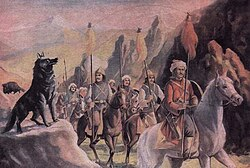
The Turks live in Ergenekon for four hundred years, and their population grows so large that they can no longer fit in the valley. The passage through which their ancestors entered has been forgotten or closed over time. Searching for a way out, the Turks examine every part of the mountains. Finally, a blacksmith notices that one point of the mountain is composed entirely of iron ore and realizes that this section can be melted. The people pile seventy rows of wood and charcoal around the mountain and place massive bellows. When the wood is ignited and the bellows are worked, the iron ore melts, opening a gap large enough for the Turks and their loaded camels to pass through.
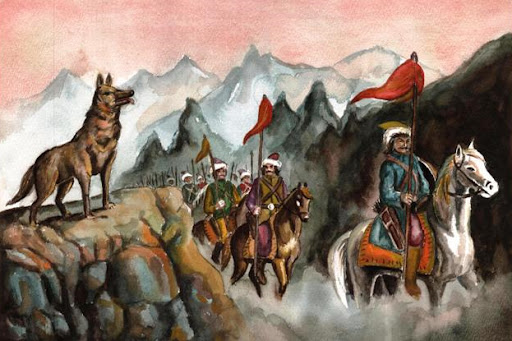
As the passage opens, a gray-maned wolf appears to guide the Turks and leads them out of the valley. Upon emerging from Ergenekon, the Turks remind the other tribes—who had long forgotten them—of their existence, reclaim their ancestral lands, and lay the foundations of the Göktürk State, once again becoming a dominant power in the world. The day of the exodus from Ergenekon is considered sacred in Turkic culture, identified with the end of winter and the arrival of spring. To commemorate this exit, the tradition of forging iron was turned into a ceremony where sovereigns strike iron on an anvil; today, this tradition continues to live on, intertwined with Nevruz celebrations. Symbolically, the epic represents the mastery of metallurgy, the passion for liberty, and social unity.
—Turkish Epic—