“Imagine an emperor who ruled over half the world, an empire upon which the sun never set. He won wars, toppled thrones, and reached the absolute pinnacle of power… Yet, at the end of all this grandeur, he stands before his own coffin in a dark monastery cell. Yes, while still very much alive, he organized his own funeral service, listened to his own funeral dirge, and watched his own passing from among black-robed monks.
So, what was that philosophical fracture that brought the most powerful man alive to the edge of his own grave while he was still drawing breath? We are pulling back the curtain on that dark ceremony where grandeur ended, and madness and the absurd began…”
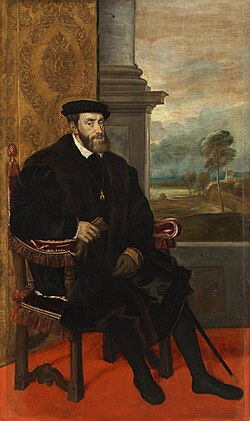
Charles V—or Karl V, as he is known in history—the man who ruled half of Europe, the gold of the Americas, and vast lands where the sun never set, began to pay the price of being the world’s most powerful monarch through a heavy psychological collapse toward the end of his life. This story is not merely about an emperor’s retirement; it is about a man’s chilling and philosophical rendezvous with his own absence.The path leading to Charles’s “funeral rehearsal” began with a tale of exhaustion and physical agony.
After years of clashing with Suleiman the Magnificent for world leadership, grappling with Protestant rebellions, and rarely dismounting his horse due to unending wars, the Emperor was physically spent by his 50s. Gout had ravaged his hands and feet to such an extent that he sometimes could not hold a pen or even eat without pain. In 1556, in a move unheard of at the time, he cast aside his crown, his throne, and all worldly ambitions. After dividing the empire between his son Philip II and his brother Ferdinand, he retreated to the Monastery of Yuste in a remote corner of Spain.
His life at the monastery resembled that of a monk more than an emperor, yet he harbored a strange obsession: Time and Death. He had brought dozens of mechanical clocks with him and spent his days trying to make them all tick at the exact same second. However, he felt a deep frustration: if a man could not bring a few clocks into the same rhythm, how could he have hoped to rule a vast empire and people of conflicting faiths? This frustration eventually morphed into a dark melancholy and an obsession with death. Charles began having masses held for his own soul every day, praying for hours in his room draped in black shrouds.

Yet, this was not enough; he wanted to personally “experience” that final moment from which every living thing flees: his own death.In August 1558, one of the strangest rituals in history took place. Charles ordered the monks to prepare a full funeral service as if he had truly died. The monastery walls were draped in black cloth, hundreds of torches were lit, and a massive catafalque was erected in the center. Wrapped in a black shroud, the Emperor lay down inside the coffin atop the catafalque. The surrounding monks and servants, holding black candles, stood in formation around the coffin and began chanting those spine-tingling funeral hymns for the peace of Charles’s soul.
From inside the coffin, Charles slightly opened his eyes to watch the tears shed for him, the rising smoke of the candles, and the rhythm of the prayers. In that moment, he was both the deceased and the sole spectator of his own death. He felt that sense of “absolute control” that power had never granted him, perhaps for the first time, while directing his own absence like a theatrical play. When the ceremony ended, he rose slowly from his coffin, thanked the bewildered monks, and quietly retreated to his cell. It was as if he had domesticated death, transforming it from an object of fear into a mechanical clock. However, this “rehearsal” had already pushed open the door to reality. Only a few weeks after this bizarre ceremony, Charles closed his eyes to life for real, holding a portrait of his late wife. He left behind not just lands, but that famous and dark curiosity regarding one’s own end.
Read more: The Emperor Who Watched His Own FuneralPhilosophical Perspective:
Baudrillard & Simulation: Jean Baudrillard’s theory of simulation is at the forefront here. Death is the only uncontrollable “absolute reality” for humans. To break the terror of this reality, Charles creates a simulation of it. Entering the coffin is essentially saying to death: “I designed you, I started you, and by rising from this coffin, I ended you.” When power can no longer manage life, it seeks to domesticate death by turning it into a “performance.”
Walter Benjamin & Melancholy: Benjamin suggests that figures at the pinnacle of power are driven toward an inevitable melancholy. The one who possesses everything is the first to realize that everything they own will eventually become “nothing.” Charles’s funeral rehearsal is the embodiment of the “Vanitas” (vanity/emptiness) philosophy. Looking out from that coffin is the acceptance that crowns, thrones, and armies are but shadows, and the final truth is that narrow wooden box.
Lacan & The Reverse Mirror: Let’s read Jacques Lacan’s “Mirror Stage” in reverse. Normally, a child sees themselves in a mirror to construct a “self”; Charles constructs his own corpse in a coffin to “deconstruct” that self. Placing his body in a coffin like an object (a cadaver) and watching it as an outside observer is the subject’s alienation from their own existence. This is that most absurd and intimate moment of detachment where a human watches their own life as a play.
Heidegger & Being-Toward-Death: Charles’s obsession with his dozens of clocks can be linked to Martin Heidegger’s concept of “Being-toward-death” (Sein-zum-Tode). Every “tick-tock” of the clocks reminded the Emperor that he was one step closer to death. When he could not synchronize the clocks, he realized that time and death are uncontrollable. The funeral rehearsal was an attempt to freeze time and stand still against its relentless flow.
“Aesthetics of Necropolitics”: The use of death not just as a biological end, but as a “staging” and an “aesthetic ritual.”“Ego-Apocalypse”: Satisfying the ego’s final desire (the desire to witness its own end) by planning and observing one’s own doomsday.“Objectification of the Body”: The reduction of the imperial body to a passive object within a religious set (the coffin).