“A woman who managed to ascend the most sacred throne of the Catholic Church in a male-dominated medieval world, relying solely on her intellect and absolute secrecy…
Was the legend of Pope Joan, which the Vatican has tried to sweep under the rug of its dusty archives for centuries, the greatest triumph of the church, or history’s most audacious and daring deception? Here is the story of that mysterious woman who altered the course of history…”
This is the story of a massive “leak” opened by a woman’s intellect and camouflage in the heart of the Vatican—one of history’s greatest male-dominated fortresses—and the tragic collapse that followed. The tale begins in 9th-century Europe, a dark age where education was strictly forbidden to women. When Joan, a brilliant young mind from Mainz (Germany), realized that the only way to satisfy her hunger for knowledge was to renounce her identity, she initiated one of history’s greatest games of deception. Disguising herself as a man, shaving her head, and taking the name “Johannes Anglicus,” Joan entered a monastery as a monk.
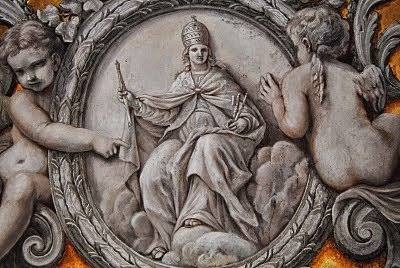
There, she quickly distinguished herself through her superior theological knowledge and oratory skills.Joan’s ascent was not a product of chance, but of systematic genius. After studying in Athens, this “young clergyman” arrived in Rome and climbed the Vatican bureaucracy with lightning speed. She inspired such trust and admiration that when Pope Leo IV died in 853, she was unanimously elected by the people and the College of Cardinals as the leader of the Catholic world—the shadow of God on Earth.
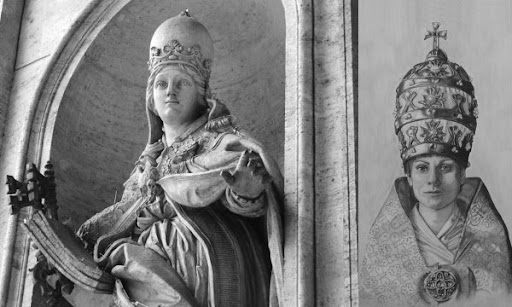
For two years, no one suspected this flawless “masculine” performance; Joan presided over ceremonies, signed decrees, and brought kings to their knees. However, this magnificent construct would be shattered by nature’s most fundamental truth: “creation.” Joan became pregnant by one of her servants and managed to hide her condition for months beneath her voluminous robes, in the very shadow of power.Disaster struck in 855 during a holy procession to St. Peter’s Basilica. While walking through a narrow street near the Church of St. Clement amidst the enthusiastic cheers of the crowds, Joan went into labor. One of history’s most jarring moments unfolded in that street: the Holy Pope gave birth to a child in full view of the Roman populace. This scene was not merely a scandal for the world of that time; it was the radical dismantling of the universal order and divine hierarchy.
Most legends suggest that Joan was either lynched by the angry mob on the spot or died shortly after childbirth. To erase this “shame” from history, the Vatican removed that street from the sacred procession routes and struck Joan’s name from the official records.The measure taken by the Church following this event is the most absurd yet symbolic aspect of the legend. According to the narratives, to ensure such a “leak” never happened again, a marble chair with a hole in the center (Sella Stercoraria) began to be used to verify that each newly elected Pope was male. A designated cardinal would reach under the chair to perform a physical check and, upon confirmation, announce: “Testiculos habet et bene pendentes” (He has testicles, and they hang well).
Philosophical Perspective:
Philosophically, the case of Pope Joan whispers this to us: no matter how perfect the armor power wears or how rigid the rules it sets, it remains vulnerable to the naked reality of the biological body. Joan proved that gender is indeed a “performance,” but she paid the most tragic price for that performance.
Judith Butler & Gender Performativity: Butler argues that gender is not a fixed innate essence but a constantly repeated “performance.” Pope Joan is living proof of this theory. For two years, she played “manhood” so flawlessly that even the most powerful men in the Catholic world did not question her authority. This shows that power is not concerned with who you are, but with how convincingly you display the “role.” When Joan donned the robes and recited Latin prayers in a masculine voice, she filled the “Pope” image in the collective mind. Gender, then, is a costume to be worn and removed on the stage of power.—–Foucault & the Traitor Body: Michel Foucault states that power seeks to control, discipline, and categorize the body. The Vatican establishes its authority by strictly dividing bodies into “male” and “female.” However, Joan’s pregnancy and childbirth represent a “bodily explosion” that falls outside this biopolitical control. No matter how heavy the armor (the church hierarchy), biological reality (labor pains) cracks that armor at its weakest point. Joan’s body became a “traitor” that exposed the magnificent lie her mind had constructed. The body is sometimes our most honest part, betraying the political projects of the mind.
Derrida & the Irony of the Pierced Chair: The Vatican’s famous “pierced chair” ritual is a quintessential Derridean irony. While the Church claims absolute authority over “manhood,” it found itself dependent on a physical verification mechanism once a woman breached the system. The need for such an absurd test to prove the presence of something (masculinity) reveals how fragile that thing actually is. That chair is the embodiment of the fear: “What if we are being deceived again?” Power no longer relies solely on words (sermons), but on a physical “part.”
Baudrillard & the Murder of Simulation: From Jean Baudrillard’s perspective, Joan’s two-year papacy was a simulation. There was no “real” Pope, yet the system functioned perfectly. Decisions were made, blessings given, and the people believed. Joan’s childbirth was the “assassination” of simulation by reality. The moment of birth in that narrow street struck like a blow, revealing that all those holy ceremonies, robes, and titles were merely “images.” When reality seeps into the simulation (the office of the papacy), the system collapses.“Silent Seepage”: In a world where knowledge and education belonged only to men, a woman crossing this “linguistic and cultural” barrier through her intellect.“Grotesque Invasion of the Body”: The sudden subversion of the most sacred and serious space (the Papal route) by the most human and “bodily” act (childbirth).“Institutional Trauma”: The massive effort of an institution (the Vatican) to erase a mistake from its history (striking the name, changing the route), which ironically serves to make that mistake immortal.