“What kind of world would it be if the earth were forged not by a warrior’s sword, but by the songs flowing from the lips of an old wizard and the egg of a duck?
Welcome to the dark and melodic world of the Kalevala—the misty Northern epic that deeply fascinated Tolkien, the father of modern fantasy literature, inspiring him to create the Elvish language and Middle-earth itself. In this realm, it is not swords that kill, but words.”
The Kalevala is the national epic of Finland, compiled in the 19th century by the physician and philologist Elias Lönnrot from oral folk verses (runes) collected across the villages of Karelia and Eastern Finland. First published in 1835 and expanded in 1849, the final version consists of 50 runes and approximately 22,000 lines. Rather than a conventional tale of war, the Kalevala possesses a lyrical and epic structure centered on the creation of the universe, shamanic incantations, and supernatural events.
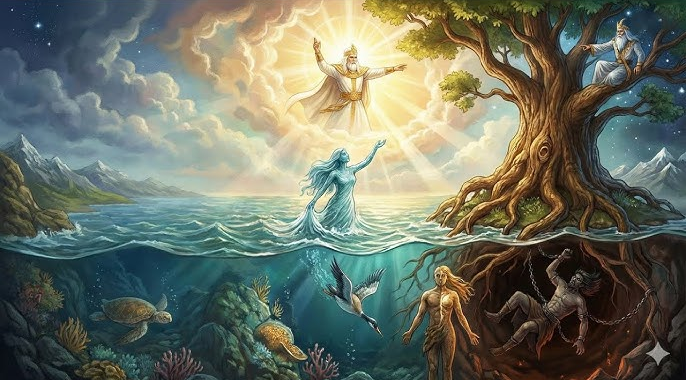
At the heart of the epic lies a creation myth that begins with Ilmatar, Daughter of the Sky, descending into the waters, and the formation of the world from the eggs of a goldeneye duck. The central protagonist is Väinämöinen, the world’s oldest bard and sorcerer born in these primordial times. Väinämöinen is not a master of the sword, but a sage who commands the world through the power of words and song—capable of freezing seas or chanting his enemies into a mire. Most of the narrative revolves around the conflicts between Kalevala (the home of Kaleva), a realm of light and prosperity, and Pohjola, the dark, cold, and hostile land of the North.
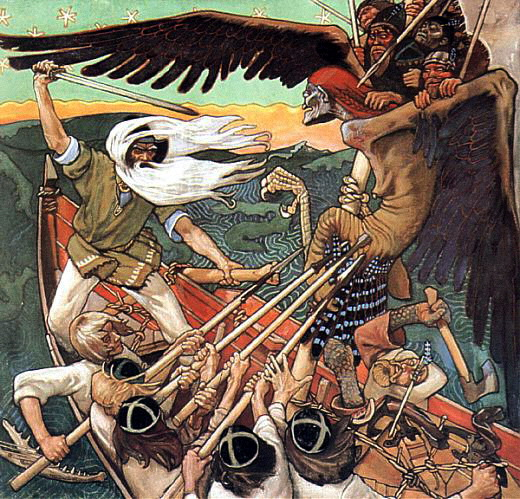
The most vital element of the epic is a magical object known as the Sampo. Forged by the divine smith Ilmarinen as a gift for Louhi, the powerful mistress of Pohjola, this object is a source of infinite wealth and abundance, grinding out flour, salt, and gold from its three sides. The efforts of the heroes of Kalevala to reclaim the Sampo form the primary axis of the epic. Eventually, the Sampo is shattered during a sea battle; some fragments fall into the sea while others wash ashore, which is traditionally accepted as the source of Finland’s prosperity.
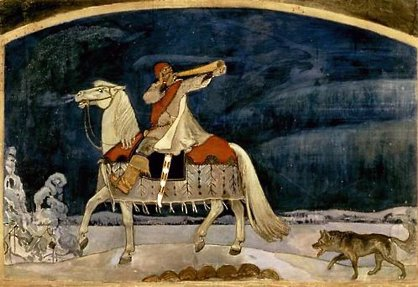
Beyond Väinämöinen and Ilmarinen, the cast of characters includes figures such as the young and adventurous Lemminkäinen and the tragic Kullervo, a slave endowed with immense power who meets a grim end. The epic concludes with a symbolic event representing the arrival of Christianity: Väinämöinen baptizes a child born to a virgin after she eats a berry, leaves his kingdom to the child, and departs the world in a boat. The Kalevala played a historical role in preserving the Finnish language and identity; it also served as a profound inspiration for modern fantasy authors like J.R.R. Tolkien in the development of fictional languages and mythological frameworks.
—Finnish Epic—