“A dragon slayer who forfeited immortality all because of a single leaf brushing against his back; a noble woman who drowned an entire empire in a sea of blood fueled by the fires of vengeance; and the cursed gold hidden at the very bottom of the Rhine, which set this entire catastrophe into motion…
This dark Germanic epic, which served as the profound inspiration for Tolkien’s The Lord of the Rings, tells a story not merely of battles fought against monsters, but of how humanity is utterly crushed under the weight of betrayal, hubris, and self-destructive ambition. So, does a man hold the strings of his own destiny, or does he weave his own gallows with those very threads?”
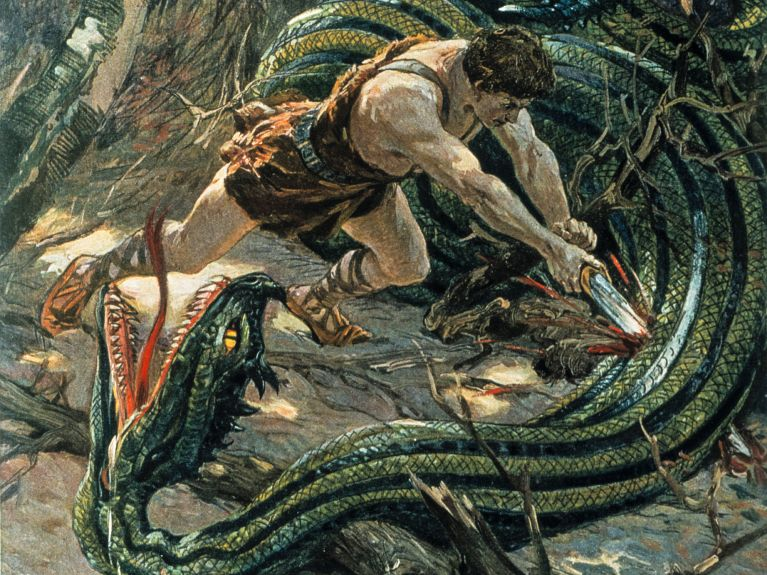
The Nibelungenlied (The Lay of the Nibelungs) is a magnificent heroic epic that serves as the cornerstone of German literature, perfectly reflecting the dark, gloomy, and grand atmosphere of the Middle Ages. This epic narrates a tragic progression ranging from the birth of a hero with unshakable power to a betrayal filled with deception, and ultimately, a woman’s horrifying revenge that annihilates an entire kingdom.At the center of the story is Siegfried, the Prince of Xanten. Siegfried killed a legendary dragon and bathed in its blood, turning his body into armor that no weapon could pierce.
However, during this bath, a small linden leaf fell between his shoulder blades, creating the only vulnerable spot on his body. Siegfried also defeated the dwarves who guarded the Nibelungen treasure, winning both an immense fortune and a magical cloak—the Tarnkappe—which grants its wearer invisibility and increases their strength tenfold. This invincible hero arrives in the city of Worms and falls in love with the beautiful Burgundian princess, Kriemhild. However, to marry her, he must help Kriemhild’s brother, King Gunther, subdue the warrior queen of Iceland, Brunhild. Brunhild has declared that she will only marry the man who can defeat her in a series of athletic duels. Using his cloak of invisibility, Siegfried competes unnoticed on Gunther’s behalf and defeats Brunhild, ensuring the marriage takes place.
Years later, a dispute over status between the two queens ruins everything. Kriemhild reveals to Brunhild that she was actually defeated through trickery and that the true victor was Siegfried, humiliating her in public. Her honor shattered, Brunhild burns with a desire for revenge and convinces Hagen von Tronje, Gunther’s most loyal but dark advisor, to kill Siegfried. Hagen deceives Kriemhild into revealing Siegfried’s vulnerable spot and, during a hunting party, treacherously stabs the hero in the back with a spear, exactly where the leaf had rested. Subsequently, Hagen seizes the Nibelungen treasure and buries it in the waters of the Rhine River so that no one may ever find it.
Kriemhild, whose life was darkened by her husband’s death, enters a period of deep mourning and hatred that lasts for years. She is prepared to risk everything for her revenge. She accepts a marriage proposal from Etzel (Attila), the Emperor of the Huns, hoping to use his military might, and travels to the lands of the Huns. After many years have passed, Kriemhild invites all her relatives and Hagen to a grand feast at the Hunnic palace. This feast quickly turns into one of the bloodiest massacres in history. The palace is set on fire, and Burgundian nobles and Hunnic warriors slaughter each other mercilessly. At the end of the story, with revenge being the only thing left to her, Kriemhild personally kills Hagen, her husband’s murderer, with Siegfried’s own sword. However, unable to withstand this blood-curdling brutality, another hero named Hildebrand kills Kriemhild on the spot. The epic ends in a bloody silence where no winners remain, and a magnificent civilization along with its great heroes are completely wiped out.
—German Epic—