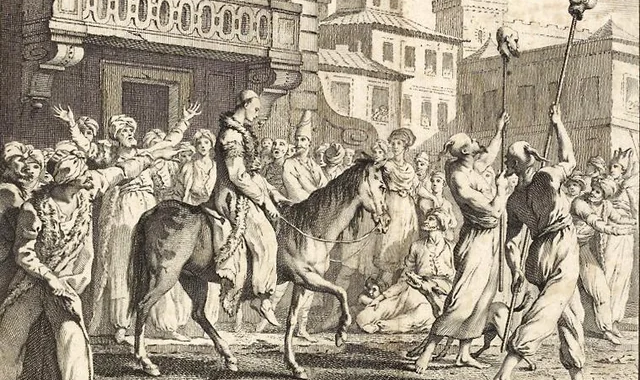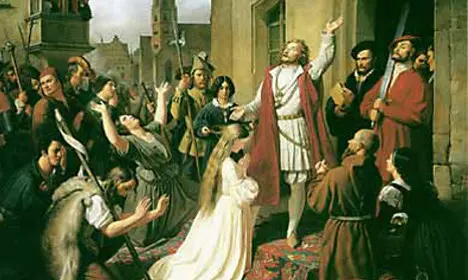
While 16th-century Germany was reeling from the birth pains of the Reformation, the city of Münster became the stage for one of history’s most radical theocratic experiments. When a group calling themselves Anabaptists seized control of the city, their intent was to establish a peaceful religious community. However, events quickly spiraled into a form of collective madness. After the city’s bishop was expelled, Jan Matthys and his successor, Jan van Leiden, turned Münster into a completely isolated camp called “New Jerusalem.”In the new order established within the city, the concept of private property was entirely erased. “Prophets” decided who would eat what and who would marry whom. When Jan van Leiden declared himself the King of the World, he had a golden throne erected in the city square and began appearing before the people in luxurious robes. Meanwhile, the populace was perishing from hunger due to the siege laid by the bishop from the outside, forced to eat cats and dogs. Van Leiden marketed the siege as a “divine test,” personally executing anyone who objected—or having them executed by his henchmen—in the public square. In one instance, when one of his wives questioned his authority, Leiden personally beheaded her in front of the public and danced around the corpse with his other wives.In June 1535, hunger and betrayal weakened the city walls. Helped by an informant who had fled the city, the bishop’s army sneaked through a secret gate. A total massacre ensued in the streets; most of the Anabaptists were put to the sword. However, the three leaders of the movement (Jan van Leiden, Bernd Knipperdolling and Bernd Krechting) were captured alive. The establishment wanted to make them pay for this radical rebellion not just with death, but with an unforgettable agony. After being displayed in cages for a year, the leaders were brought back to the Münster square.On the day of execution, thousands filled the square. For a full hour, the three leaders were tortured with glowing-hot pincers that tore flesh from their bodies. Executioners pulled their tongues through their throats and ripped them out to prevent them from speaking. Finally, their lives were ended with red-hot daggers plunged into their chests. Yet, even this brutality did not satisfy the authorities’ rage.The mangled corpses were placed in iron cages, each the size of a human. These cages were hung from the spire of St. Lambert’s Church, the highest point in the city. The aim was not just to punish the criminal, but to force the entire city to watch the process of the corpses rotting. As birds tore the bodies apart, the bones drifted down from those cages for years. This “spectacle” turned into a silent vigil representing the unshakeable authority of the state. Those cages remained there for 486 years. Today, the empty irons still swaying on the church tower persist as the most concrete and darkest remnants of religion, state violence, and human hubris.
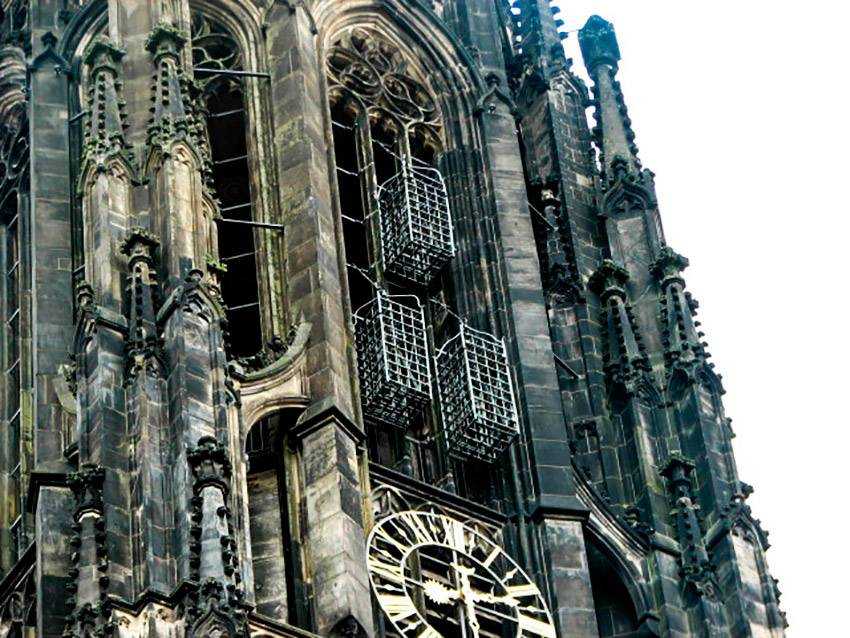
Read more: The Münster Rebellion and the Iron Cages
Philosophical Dimension:
The first name we encounter here is Michel Foucault. In his work Discipline and Punish, Foucault points exactly to this issue of “public torture.” Let’s discuss: Why didn’t the bishop simply hang and bury the rebels? Why did he let those corpses rot on that tower for 500 years? Foucault argues that what is being punished here is not the “criminal,” but rather “the eye of the public.” Power transforms those corpses into a ritual of truth. That is to say, as long as those cages sway there, the bishop’s power is reborn every morning. At this point, we must ask: Does the power that governs you claim your body, or the “image of fear” in your mind? The mind that mowed down emus with machine guns today is the same mind that hung those cages then: “I am here, and I define the boundaries of nature or man.”
The State of Exception and “Sacred Man” Now let’s look at the other side—at Jan van Leiden, who turned the city into “New Jerusalem.” Giorgio Agamben’s theory of the “State of Exception” comes into play here. Leiden built an invisible wall around the city and pushed everyone inside outside the law. Inside, there is no money, no property—only the whim of the leader. Agamben calls this “Homo Sacer” (Sacred Man). You are at a point where you can be killed, but your death is not considered a murder because you are no longer a “citizen”; you are a “statistic” in the leader’s hands. The people of Münster had already become living corpses in the hands of their own leader long before they were hung from that tower. I open this for discussion: Is agreeing to become “bare life” for the sake of an ideology any less terrifying than entering that iron cage?
Spectacle and Memory: Why Are the Cages Still There? Finally, we come to the most striking part. In The Society of the Spectacle, Guy Debord argues that images have replaced reality. The cages are empty today, yes. But why aren’t they taken down? Because those cages are no longer objects; they are symbols. From Debord’s perspective, even if the state says, “I have changed, I no longer practice torture,” it keeps your memory alive by keeping those cages there. It is a spectacle of silent threat. The image (empty cages) has replaced the reality (the bones of the rebels).