“A man free enough to stand before Alexander the Great, who made the entire world kneel, and say, ‘Stand out of my light, I ask for no other favor…
So, what kind of hypocrisy of ours was Diogenes actually chasing when he shouted, ‘I am looking for a human being!’ with a lantern in his hand during broad daylight in the streets of Athens?”
The life of Diogenes, as conveyed to us by ancient sources, is a true chronology that began with exile, passed through a slave market, and transformed into a challenge posed to one of history’s greatest rulers. Born in Sinope around 412 BCE, Diogenes faced accusations of “defacing the state currency” alongside his father, Hicesias, who was in charge of the mint. As a result of this historical forgery case, his father was imprisoned while Diogenes was exiled from Sinope. This forced migration drove him to Athens, the intellectual center of the Greek world. Upon arriving in Athens, he sought out Antisthenes, a pupil of Socrates. Despite initially being driven away with a staff, Diogenes persisted until he was accepted, eventually pushing Antisthenes’ ascetic teachings to their absolute extreme.
Refusing to own any property during his life in Athens, Diogenes met his need for shelter by living in a massive wine jar, known as a pithos, located near the Temple of the Metroon. According to historical records, to acclimate his body to the elements, he would embrace frozen statues in the winter and lie on scorching sands in the summer. However, the greatest turning point in his life occurred when he was kidnapped by pirates near Aegina during a voyage. When put up for sale at a slave market in Crete, he responded to the auctioneer’s question, “What do you know how to do?” by stating, “I know how to govern men.” He was subsequently purchased by Xeniades, a wealthy Corinthian, and settled in Corinth as a tutor for Xeniades’ children.
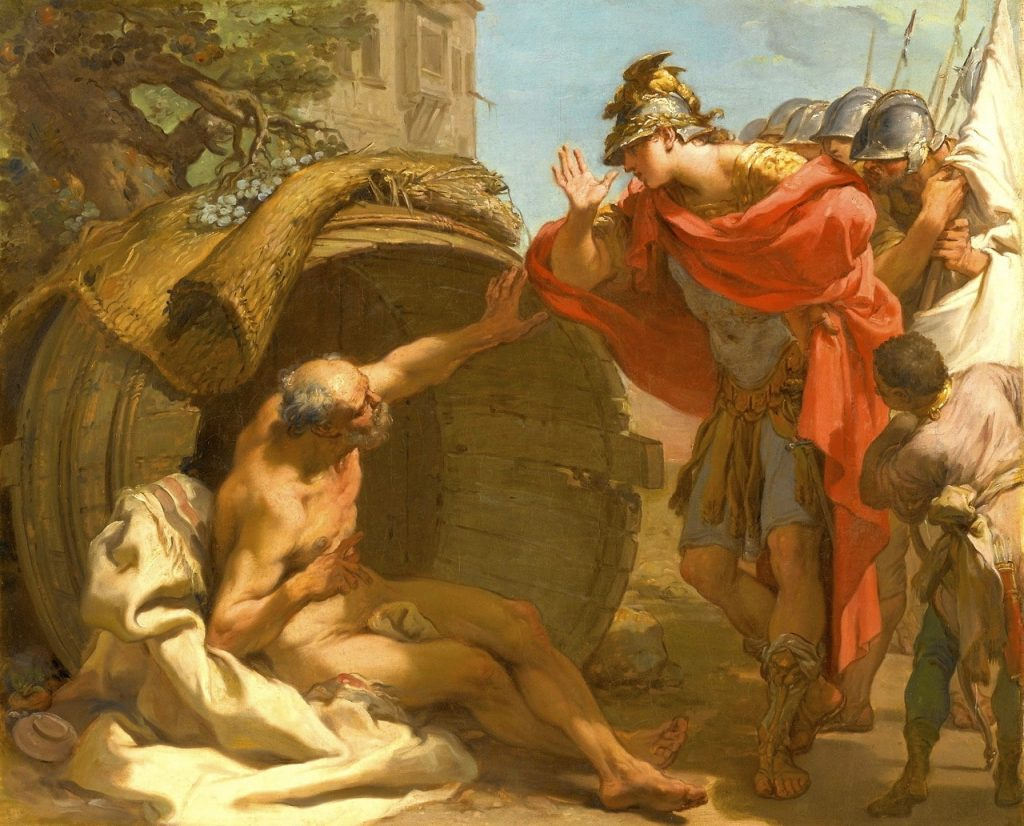
Diogenes’ life in Corinth, where he spent the remainder of his days, set the stage for one of the most iconic encounters in world history in 336 BCE. When Alexander the Great came to Corinth to solidify the unity of the Greek city-states, he personally visited Diogenes, who—unlike everyone else—had not come to pay his respects. As Diogenes was sunbathing, Alexander stood before him and said, “Ask of me any boon you desire.” Without even shifting his position, Diogenes replied, “Stand out of my light; I ask for nothing else,” as the King was blocking his sun. This remains one of the most shocking historical dialogues ever recorded during an official royal visit.
In a twist of fate, his death occurred in 323 BCE, the same year as Alexander the Great. Some ancient sources claim he choked while trying to swallow a raw octopus, while others suggest he died from a dog bite. There are even rumors that he took his own life by holding his breath. Upon his death, the people of Corinth held a grand funeral for him and erected a marble pillar topped with a dog statue over his grave. His fellow citizens in Sinope later honored his indelible mark on world history by casting bronze statues in the name of the man they had once driven from their city.