“A genius sultan who, at just 17 years old, wanted to change the destiny of a vast empire… And that very sultan, dragged through marketplaces by the soldiers of the army he built, met his end by being strangled in the darkest dungeon of history.
Was this bloody rebellion, which Ottoman historians named ‘Haile-i Osmaniye’—meaning the Great Tragedy—merely the death of a padishah, or was it the turning point where an entire state handed its own future over to the executioner?”
When Sultan Osman II (Genç Osman) ascended the throne at the age of 14, he was a very young and fiery reformer who realized that the empire’s institutions had rotted. During the Polish campaign (the Battle of Khotyn), he personally witnessed the indiscipline of the army and how the Janissaries pursued plunder instead of fighting. Genç Osman had a revolutionary plan in mind: to abolish the corrupted Janissary Corps, move the capital from Istanbul to Anatolia (perhaps Bursa), and establish a new army composed entirely of Turks. However, these plans meant a “death warrant” for the military and religious bureaucracy that had considered themselves the owners of the state for centuries.When rumors spread that the Sultan would cross into Anatolia under the pretext of going on a pilgrimage (Hajj) to gather an army, the Janissaries and Sipahis revolted.
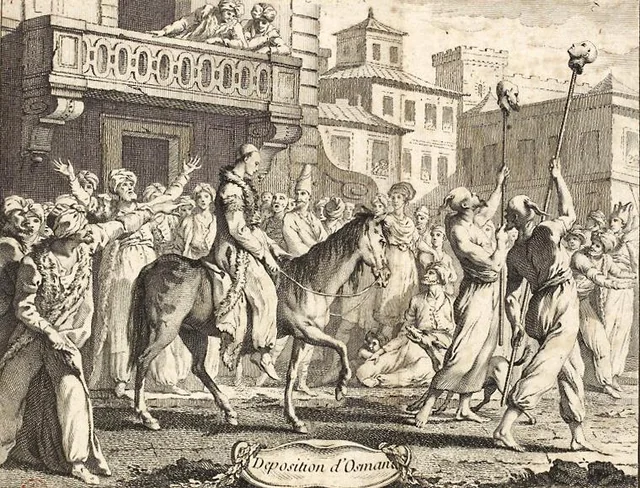
The events instantly turned into an uncontrollable flood of hatred. When the rebels entered the palace, they violated the privacy of the Sultan, who had been considered “unreachable” and “sacred” for centuries. Genç Osman was taken from the palace and dragged through the streets—where his subjects once bowed before him—like an ordinary criminal.The most shocking detail here is the psychological violence inflicted by the public and the soldiers. The Sultan was dressed in an old, dirty robe; a makeshift turban was placed on his head, and he was mounted upon a mangy horse. Along the way, he was subjected to the insults of the masses. When he was thirsty, the water given to him was mixed with filth—this was proof of how a supreme office (the Caliphate and Sultanate), rather than just an individual, was reduced to “nothingness” in the eyes of society.
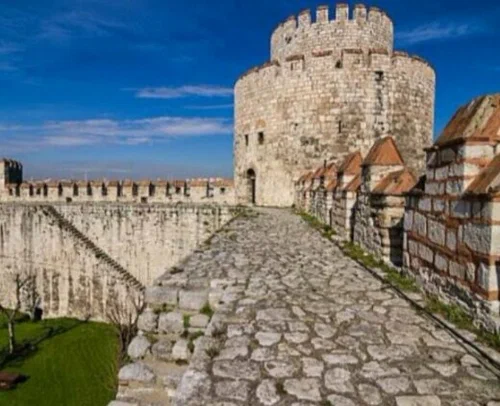
The rebels imprisoned Genç Osman in the Yedikule Dungeons. Normally, in Ottoman tradition, the blood of Sultans would not be shed; they were strangled with a bowstring. However, at 18, Genç Osman was an athletic and very strong young man. He put up a legendary resistance against the executioners who came to strangle him within the narrow confines of the dungeon. For minutes, he managed to escape the noose and injured several executioners.It was at this point that the most “bizarre” and darkest moment in history occurred: to stop the Sultan whom they could not physically overpower, the executioners resorted to a method that completely disregarded human dignity and sanctity.
One of the executioners approached Osman from behind and squeezed his testicles with all his might, paralyzing him with pain. When the Sultan collapsed in agony, his resistance was completely broken. Only at that moment could the noose be tightened around his neck. After he was strangled to death, the Sultan’s ears were cut off to be taken to the leaders of the rebellion as proof of his demise.
Read more: The Tragic Fate of Osman II: The First Ottoman Sultan Murdered by His Own ArmyPhilosophical Dimension:
This story is not just the tragic death of a young Sultan; it is the story of how a society pops the “sanctity” bubble it created with its own hands. Imagine: today you drag through the streets on a mangy horse the very man you bowed before yesterday, calling him “the shadow of God on earth.”
Genç Osman was actually a visionary youth; the moment he said, “This army is broken, I must build a new force from my own people in Anatolia,” he signed his own death warrant. But what is truly horrifying is not the politics, but what happened in those final hours. When the rebels took him from the palace, they did not just take his throne; they took his “human dignity.” Do you know what it means to dress a Sultan in a dirty robe and give him water mixed with filth when he is thirsty? It means: “You are no longer that sacred Sultan we cannot reach; you are a piece of flesh that is our toy.”
Imagine that 18-year-old youth struggling for hours with executioners in that cramped, damp room of Yedikule. The owner of a vast empire is fighting for his life with his bare fingernails. And at that exact point, the moment an executioner approaches from behind and makes that certain private move (paralyzing him by crushing his testicles), an imperial ideology kneels there alongside a physical body. At that moment, neither law nor sanctity remains; there is only a suffering body and a crude force dominating that body.
This event teaches us this: even the greatest powers can vanish within seconds between the fingers of an executioner once the image of “respect” in the mind of society is destroyed. Haile-i Osmaniye is the bloodiest document of how power is actually a fragile illusion.
State of Exception (İstisna Hali): That moment of lawless and dark chaos where rules are set aside and “everything is now permissible.”
Grotesque Realism: The reduction of that which is seen as most sublime and unreachable to the most wretched state through hunger, thirst, and physical humiliation.
Homo Sacer: The abandoned human who is pushed outside the law, whose killing is no longer considered a crime, and who is left as mere “bare life.”